
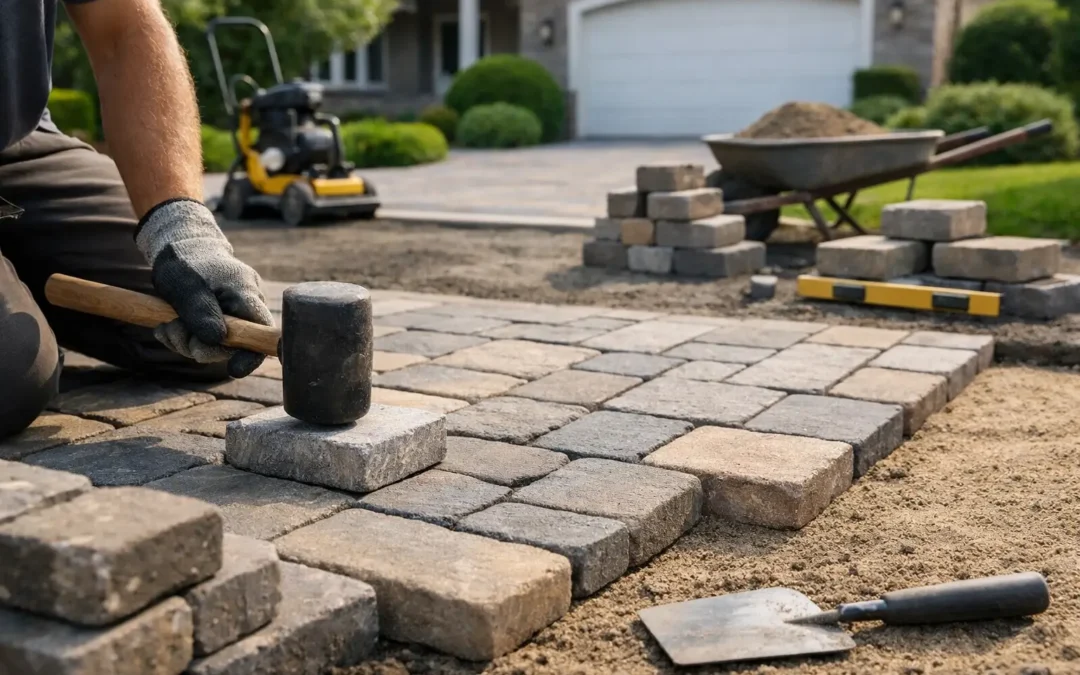
A driveway has a demanding job. It carries daily vehicle weight, stands up to rain and summer heat, frames the front of your home, and often becomes the first detail guests notice. When the surface is cracked, stained, uneven, or simply too plain for the property, pavers offer a more polished alternative to a standard poured slab.
For homeowners considering driveway paver installation Greenville SC projects, the visual choice is only one part of the decision. The real performance of a paver driveway comes from what happens beneath the surface: excavation, grading, drainage, base preparation, and edge restraint. Those details determine whether the finished driveway stays attractive and stable through years of Upstate South Carolina weather.
Why Pavers Work Well for Upstate Driveways
Concrete pavers create a driveway with depth, pattern, and character that can complement nearly any home style. A traditional brick paver can suit a classic Greenville bungalow or a historic-style home near Travelers Rest. Clean-lined concrete pavers in charcoal, sand, or warm gray can give a newer home in Simpsonville, Greer, or Mauldin a more tailored entrance.
Appearance is only part of the advantage. Individual pavers are designed to work as an interlocking system. With a properly compacted base and secure perimeter, the pavers distribute vehicle loads across the surface rather than relying on one continuous slab. That makes them a strong choice for driveways, parking pads, motor courts, and transitions to front walks.
Pavers also offer practical repair flexibility. If a utility line needs access or a limited area becomes damaged, affected units can often be lifted, the base corrected, and matching pavers reset. A cracked concrete driveway usually requires a more visible patch or section replacement.
That does not mean pavers are right for every project. They typically require a greater upfront investment than basic concrete, especially when the existing driveway needs extensive excavation or drainage correction. They also demand careful installation. A beautiful paver selected for the wrong base is not a long-term solution.
Driveway Paver Installation in Greenville SC Starts Below Grade
A driveway should never be treated like a patio with a few extra pavers. Vehicles place substantially more stress on the surface, so the foundation must be designed for the property, soil conditions, and expected traffic.
Excavation and grading set the direction
The installation begins by removing existing asphalt, concrete, grass, or unstable material and excavating to the depth required for the complete driveway system. That depth depends on factors such as soil condition, slope, paver thickness, and whether the driveway will serve passenger vehicles only or heavier equipment.
Just as important, the area is graded with water in mind. Upstate SC receives significant rainfall, and water that collects at the garage, flows toward the house, or runs across a sidewalk creates problems far beyond the driveway itself. A well-planned slope guides runoff away from structures and prevents low spots where water can weaken the base over time.
Some properties in Easley, Pickens, and the foothills have noticeable grades that require additional planning. In those situations, the driveway may need swales, drains, retaining features, or thoughtfully placed landscape beds to manage water while keeping the entrance visually balanced.
The compacted aggregate base carries the load
After excavation and grading, a contractor installs a layered aggregate base. The material is placed in controlled lifts and compacted thoroughly rather than dumped in at full depth and packed only at the top. Proper compaction is what creates a stable platform for the pavers and helps reduce shifting, settlement, and ruts.
The necessary base depth is not a one-size-fits-all number. Clay-heavy soil, poor drainage, a steep drive, or a driveway that sees delivery trucks may call for a more substantial build-up than a level parking area serving two family vehicles. This is one reason a site evaluation matters before a contractor offers a final scope and price.
A bedding layer is then screeded over the compacted base to create a precise setting surface. Pavers are placed on that layer in the chosen pattern, then compacted and jointed so they function as a unified surface.
Edge restraints are not an optional finishing touch
The outside edges of a driveway experience constant outward pressure from traffic and seasonal movement. Without a durable restraint system, pavers can slowly spread apart, opening joints and compromising the clean lines of the installation.
Concrete edge restraints, concealed restraints, or curbing may be used based on the driveway design and adjacent features. The right option depends on whether the driveway meets a lawn, retaining wall, sidewalk, garden border, or existing hardscape. Good edge detailing keeps the driveway looking intentional instead of unfinished.
Selecting Pavers That Fit Your Home
Driveway pavers should be rated and sized for vehicular use. A product that looks excellent around a firepit or garden path may not have the thickness or strength needed beneath a vehicle. Material selection should begin with performance, then move to color, texture, and pattern.
Concrete pavers are a versatile choice for many Upstate homes. They are available in a broad range of colors, shapes, and surface finishes, making it possible to create a subtle driveway that supports the architecture rather than competing with it. Brick pavers bring timeless warmth and can be especially effective when the home already includes brick accents. Natural stone can create an elevated look, but cost, thickness variation, and maintenance expectations should be considered carefully.
Color deserves a practical conversation as well. Very light pavers can show tire marks and red clay more readily. Very dark surfaces may absorb more heat in direct sun. Blended tones, textured finishes, and mid-range colors often provide a forgiving, natural-looking option for active family homes.
Pattern influences both style and stability. Running bond, herringbone, basket weave, and linear layouts each create a different visual effect. Herringbone is commonly favored for driveways because its interlocking arrangement handles turning and braking forces well. A border in a contrasting paver can define the driveway edges and tie the design into front steps, walkways, or a patio.
Design the Driveway as Part of the Whole Property
The strongest driveway projects do more than replace a worn surface. They organize the approach to the home and create a better relationship between the street, landscape, and entry.
A widened parking area can make daily arrivals easier for a growing household. A curved paver walk can carry guests from the driveway to the front door without cutting through the lawn. Low planting beds can soften broad paved areas, while landscape lighting can make the entrance safer and more distinguished after dark. For homes with a backyard renovation planned later, matching pavers can create continuity from the front driveway to a side path, pool deck, or outdoor living area.
There are trade-offs. More paving may improve parking and reduce muddy areas, but it can also increase runoff and make a front yard feel harder if it is not balanced with planting space. The best layout respects how the household actually uses the property while preserving room for greenery and drainage.
What Homeowners Should Expect During Installation
Driveway construction is active work. Equipment, base materials, cutting, compaction, and cleanup are all part of the process. A professional crew should clearly explain access needs, vehicle parking arrangements, the anticipated schedule, and any periods when the driveway cannot be used.
The duration depends on the driveway size, demolition requirements, weather, drainage improvements, and design complexity. A straightforward replacement moves differently than a project involving a new layout, retaining wall, front walk, and landscape renovation. Honest planning is better than a rushed promise, particularly when rain affects excavation or base compaction.
Before work begins, homeowners should confirm the final paver selection, pattern, border details, drainage plan, and how the project will meet existing sidewalks, garage thresholds, and streets. It is also wise to discuss whether the quote includes removal and disposal of the old surface, site protection, final cleaning, and restoration of disturbed lawn or planting areas.
At Innova Hardland, the goal is not simply to install a new hard surface. It is to build an entrance that feels considered, functions reliably, and fits the rest of the outdoor environment. Clean jobsites, responsive communication, and careful finishing are part of delivering a driveway homeowners can enjoy every time they pull in.
Protecting a Paver Driveway After Installation
Paver driveways are relatively straightforward to maintain, but they are not maintenance-free. Regular sweeping keeps debris from settling into joints, and occasional rinsing removes seasonal dirt and pollen. Spills from oil, fertilizer, or paint should be addressed promptly, following the recommended cleaner for the specific paver material.
Joint sand may need replenishment over time, especially after heavy rain or pressure washing. Polymer-enhanced joint sand can help resist washout and discourage weed growth when installed correctly. Sealing is optional in many cases. It can enrich color and provide stain resistance, but it should be selected carefully because some sealers alter surface sheen and may require future maintenance.
If you notice a low spot, loose edge, recurring puddle, or movement near a drain, address it early. Small corrections are easier before water and traffic create a larger base issue.
A well-built paver driveway brings everyday utility and lasting curb appeal together. With the right materials, drainage strategy, and foundation beneath every paver, it can become a practical first impression that supports your home for years ahead.